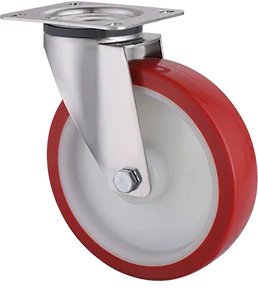
How to Choose All-Terrain Castors for Rough and Uneven Floors
Assess the complete trolley route before specifying all-terrain castors. Use six surface examples to check wheel construction, loading, steering, brakes and the evidence needed for an OEM enquiry.
Key takeaways
- Specify all-terrain castors against the entire loaded route, including joints, transitions, debris and parking conditions.
- Compare diameter, tread construction and width together; a soft or large wheel alone does not establish suitability.
- Confirm dynamic load conditions and separate steering locks, parking locks and service braking.
- Use the surface checklist below to agree a sample configuration and measurable trolley trials.
All-terrain castor selection starts with a defined operating envelope for the loaded trolley. An industrial route can combine workshop floors with outdoor handling areas. When assessing rough-terrain castors, check each transition as well as continuous travel. A wheel that rolls comfortably over a joint may still struggle when turning or meet sharp debris. Specify the complete castor assembly and verify it on the loaded equipment.
Measure the route before choosing a wheel
Divide the route into surface sections and transitions. Record joint width and depth, step height, threshold shape, gradients and available turning space. Use mm for dimensions and record how slopes were measured. Include wet areas, dust, loose particles, sharp fragments and cleaning chemicals. Photograph each observation with a scale; surface names alone leave important conditions undefined.
Record trolley mass, maximum payload and permitted load positions, including partial unloading. Describe manual movement separately from towing, with travel frequency, operating speed, distance and stationary periods. An indoor-to-outdoor route may also expose bearings and brackets to water or contamination. Match the specification to the most demanding permitted section and check that handling remains acceptable on the easier sections.
Turn floor observations into specification checks
The six photographs are visual examples, without a scale or verified material analysis. They show features to investigate, rather than a tested match between a floor and a castor. The table is an engineering review checklist: agree the actual measurements and acceptance criteria for your equipment before testing.
| Surface observation | Specification to check | Route trial to agree |
|---|---|---|
| Tiled surface with joints | Joint geometry, wheel diameter, tread resilience and floor protection. | Cross representative joints in both travel directions; record impacts and starting force. |
| Rough aggregate surface | Confirm whether particles are bonded or loose; inspect tread cut resistance and bearing protection. | Inspect the tread and fork for damage or trapped particles after repeated passes. |
| Stone paving with joints | Measure local height differences, gaps, frame clearance and wheel contact. | Cross the least favourable permitted transition with the specified load positions. |
| Metal chequer plate | Raised pattern, edge transitions, noise, tread contact and wet contamination. | Check steering, load movement and parking on the actual plate condition. |
| Coarse aggregate surface | Verify surface firmness and particle movement; assess width, tread and operating duty. | Observe sinkage, rutting or increasing push force where these conditions occur. |
| Smooth finished floor | Confirm finish compatibility, marking requirements and the transition to rougher sections. | Compare starting, sustained travel and turning; inspect for marks or scuffing. |






Where inspection confirms loose gravel, record layer depth and movement under load. A wider wheel can change its interaction with yielding ground, but width alone does not prove flotation or easy steering. If wheels sink, stones jam the fork or debris cuts the tread, consider route maintenance or a different handling method alongside castor changes.
Balance diameter, tread construction and width
Larger diameters generally make discrete obstacles easier to cross, but the result also depends on obstacle shape, wheel deformation and load. Compare measured step height with the proposed wheel diameter, then check the complete installation height and swept clearance. Raising the trolley can affect loading height and stability. Blickle's handling guidance identifies diameter, tread, bearing and offset as interacting factors.
Compare tread material and tyre construction separately; the categories below can overlap. Hardness and rebound resilience describe different properties. Fallshaw's wheel-selection guide explains their influence on effort and comfort. Compare the proposed compound on your route.
| Option | Potential reason to evaluate | Confirmation needed |
|---|---|---|
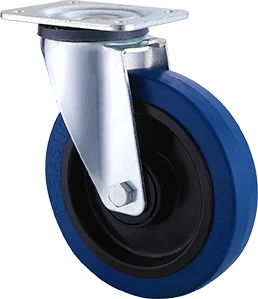
| Solid elastic rubber | Cushioning over joints without an air chamber. | Loaded deflection, starting effort, wear and marking behaviour of the actual compound. |
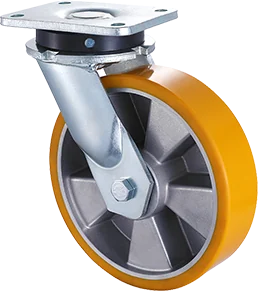
| Polyurethane tread | A candidate where wear and load support matter. | Formulation, hardness, resilience, tread thickness and performance across transitions. |
| Pneumatic tyre | Air-supported compliance for uneven routes. | Specified inflation pressure, load rating, puncture exposure, maintenance and clearance under deflection. |
| Non-pneumatic resilient construction | A candidate where inflation maintenance is undesirable. | Exact solid or filled construction; compare comfort, deformation, effort and load evidence. |
Material names do not fix rolling resistance. Hardness, resilience, profile and bearings also matter; soft tread can cushion a joint while requiring more effort in another part of the route. Compare the actual constructions under identical conditions. Blickle's wheel-series explanation separates starting, rolling and swivel resistance. Its catalogue test conditions should not be treated as your site results. Ask suppliers which constructions they can propose and obtain the exact model specification. For further tread distinctions, use the rubber, polyurethane and polyamide comparison.
Confirm load duty and environmental protection
Ask for the complete castor's dynamic rating and its stated speed, floor, temperature and duty conditions. A static rating describes a different condition. Uneven contact, an off-centre payload and repeated impacts can change the forces carried by individual castors. Use the castor load capacity calculation guide to establish the load basis, then ask the supplier to assess the actual route. Do not divide total mass by installed wheel count without checking load sharing.
Request the rating test method, report reference and exact tested configuration. Confirm that the duty assessment addresses your obstacles and travel pattern. Blickle's classification guide describes different test conditions for castor categories; those conditions are a reason to examine the evidence, not a universal approval for rough-ground use.
Check the bearings, seals, swivel head, axle, fasteners and bracket finish for the stated water, grit and chemical exposure. A corrosion-resistant bracket does not establish equal protection for every component. Specify cleaning and inspection access, lubricant requirements and replacement criteria. For pneumatic constructions, agree the manufacturer's pressure and inspection instructions rather than choosing a universal pressure.
Check swivelling and brakes through each transition
Swivel castors need space to reorient when the trolley starts or reverses. Measure that effort with the specified load, including on joints and textured plate. Directional locking constrains steering; it does not automatically stop wheel rotation. Confirm whether the chosen brake locks only wheel rotation (wheel brake) or both the wheel and swivel head (total lock). Confirm pedal access after the trolley is positioned and follow the castor mounting and control guide for the underlying terminology. Use the trolley castor layout guide for frame-level choices, then evaluate that layout on your route.
Separate parking from braking during travel. Where a slope is part of the permitted route, specify its measured geometry, loading and surface condition and obtain an engineered stopping and holding assessment. A parking-lock label does not establish a permissible slope or stopping distance. Evaluate the complete trolley and operating method, including loss of contact or contaminated tread, before approving that route.
Validate a loaded trolley against agreed criteria
Use the same frame, payload position and operating method when comparing candidates. Have the equipment manufacturer set acceptance criteria before a controlled trial. Record starting and sustained push force in N, steering effort, load movement and any loss of wheel contact. Include starts with swivel castors not aligned with the intended travel direction, repeated joint crossings, stops and the transition back to the smooth floor. Record pneumatic pressure and ambient conditions where relevant so results can be compared.
After the agreed duty cycle, inspect tread cuts, embedded debris, bearing roughness, loosened fixings and brake engagement. Record the configuration revision and defects alongside the measurements. The HSE pushing and pulling guidance highlights route, floor condition, load stability and effective brakes as assessment factors. A successful dry run should not be extended to an untested wet or contaminated condition.
Prepare an OEM enquiry for your route
For an OEM castor enquiry, start with the details available and add the remaining duty information as it is confirmed:
- Equipment: Trolley or equipment type, intended use and current handling problem.
- Loading: Empty mass, maximum payload, load positions, castor quantity and layout, including changing loads.
- Route: Photos, measured gaps, raised edges and gradients; bonded or loose surfaces, sharp debris and indoor-to-outdoor transitions.
- Duty: Manual or powered movement, intended speed, distance, starts and stops, temperature and time parked under load.
- Installation: Mounting drawing, hole pattern, available height, proposed diameter and width, and clearance through turns.
- Exposure: Known tread specification, water, cleaning chemicals, dirt, corrosion exposure and floor-marking requirements.
- Controls and validation: Steering, wheel and swivel locking, service braking needs and the equipment manufacturer's route-trial criteria.
- Procurement: Prototype quantity, expected order volume, destination, target delivery date and required technical documentation.
Share your loaded trolley weight, mounting drawing and route photos with Taishan Castors. Include measured joints or raised edges so we can discuss the specifications to confirm before quotation. Send your castor requirements to begin that discussion. Ask the supplier to identify the proposed model, rating conditions, component protection and brake functions, then agree the route evaluation before approving the specification.